
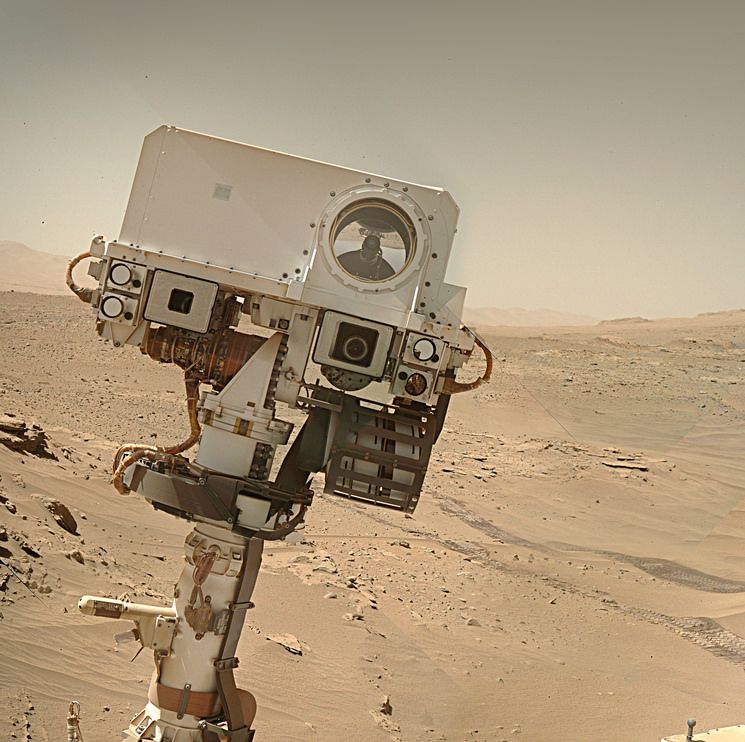
R-MastCam mosaic by Kevin M Gill, captured from the location where they just drilled the ridge above the hollow that they had already drilled / sampled a week earlier. View full size to see the details. Credits: NASA/JPL-Caltech/MSSS/Kevin M Gill
It’s not specific to this photo but I just wanted to share my thoughts: This feels so surreal. First of all, the red planet is really red. The sand is red and rocks are red. Makes sense, but it’s still a bit wild to acknowledge. Second, it just… is? It’s a giant rock floating in space unfathomably far away (though close on a cosmic scale) where no human has ever set foot and we sent a robot with a camera there and we get the pictures back and yep, it’s rocks. Looks kinda same as it does here. There’s nothing magical, otherwordly or unusual. Just lots of rocks and they are red (or maybe orange? Some shades of brown in there as well)
It’s so unreal and yet so normal.
Today it looks like many of the arid deserts here on Earth. It was formed from the same stuff and evidence shows that it once had plenty of liquid water, that was around four billion years ago, Mars had a strong magnetic field, created, just like Earth’s, by convection currents of molten metals in the planet’s core. But, unlike Earth, Mars (being much smaller than Earth) cooled enough internally to switch off that mechanism, and the planet ended up with very little global magnetic field. Without a strong magnetic field, the planet was less protected from the solar wind – the streams of energetic charged particles flowing from our Sun. The solar wind stripped away most of the Martian atmosphere in only a few hundred million years after Mars slowly lost its magnetic field. The loss of a large fraction of its atmosphere to space was a major cause of Mars’s transition from a warm, wet climate to today’s cold, dry one. As for the colour, most of the colours we see are from the dust that contains levels of iron oxide (rust). When the rover drills into these rocks we see the true colours of the rocks, many are different shades of grey (just like on Earth) others are tones of red. I’ve attached a composite image featuring the first 42 holes drilled by Curiosity since it landed in August 2012, see all the different colours (under the thin coating of red dust.

I haven’t considered that they might be gray under the red dust, but it makes perfect sense. Thanks for sharing that!
LOVE this image. Thanks for curating here Paul. Used to avidly follow your posts on Reddit. Cheers!

