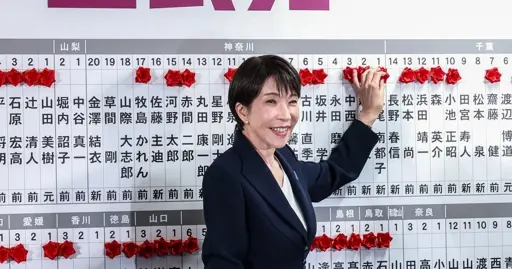
The Japanese leader's election gambit, fueled by the power of her personality and some unlikely help from young voters consumed by “Sanamania,” appears to have paid off.
Hokkaido was only made a part of the Japanese state in the late 1800s. The young Japanese Empire specifically modeled its practices in Hokkaido off of the American settler project as part of their bid for imperial legitimacy in the eyes of Europe and to secure a huge chunk of nearby land. They eradicated the indigenous Ainu people, who today exist in extremely small numbers with an extinct language. The vast majority of the Hokkaido population are ethnic Japanese settlers/settler descended who can only trace their roots on the island to within the last 150 years.
Japan’s relationship with Hokkaido is much older than that; there were outposts on the island for centuries facilitating trade with the Ainu and some permanent colonies during the Tokugawa era. But the colonization and subjugation of the island is a modern phenomena just as settler-colonial as the US or Israel.
The Ainu people are indigenous to Northern Japan and southeast Russia, in Japan they lived a lot on the northern island of Hokkaido (where the Sinnoh region was based off of for any Pokemon fans) and has faced forced assimilation and other colonial shit by the Yamato Japanese settlers.
Much more southern is Ryukyu (more likely you’ve heard this called Okinawa), which the Ryukyuans are indigenous to. To this day, there are still protests for Ryukyu’s independence where a wikipedia page on the matter can be found here.
The modern Japanese people aren’t indigenous to Japan - the Ainu are and probably some other groups, plus the Ryukyuan people of Okinawa and the other Ryukyu islands. I don’t know if they’re technically settler-colonial in a Marxist sense, but I assume that’s what the other commenter is talking about
How so? I’m interested in hearing more about that.
Hokkaido was only made a part of the Japanese state in the late 1800s. The young Japanese Empire specifically modeled its practices in Hokkaido off of the American settler project as part of their bid for imperial legitimacy in the eyes of Europe and to secure a huge chunk of nearby land. They eradicated the indigenous Ainu people, who today exist in extremely small numbers with an extinct language. The vast majority of the Hokkaido population are ethnic Japanese settlers/settler descended who can only trace their roots on the island to within the last 150 years.
Japan’s relationship with Hokkaido is much older than that; there were outposts on the island for centuries facilitating trade with the Ainu and some permanent colonies during the Tokugawa era. But the colonization and subjugation of the island is a modern phenomena just as settler-colonial as the US or Israel.
The Ainu people are indigenous to Northern Japan and southeast Russia, in Japan they lived a lot on the northern island of Hokkaido (where the Sinnoh region was based off of for any Pokemon fans) and has faced forced assimilation and other colonial shit by the Yamato Japanese settlers.
Much more southern is Ryukyu (more likely you’ve heard this called Okinawa), which the Ryukyuans are indigenous to. To this day, there are still protests for Ryukyu’s independence where a wikipedia page on the matter can be found here.
The modern Japanese people aren’t indigenous to Japan - the Ainu are and probably some other groups, plus the Ryukyuan people of Okinawa and the other Ryukyu islands. I don’t know if they’re technically settler-colonial in a Marxist sense, but I assume that’s what the other commenter is talking about
They are specifically in Hokkaido. On mainland Japan, no. It was not too different from any other large scale migration in antiquity.