

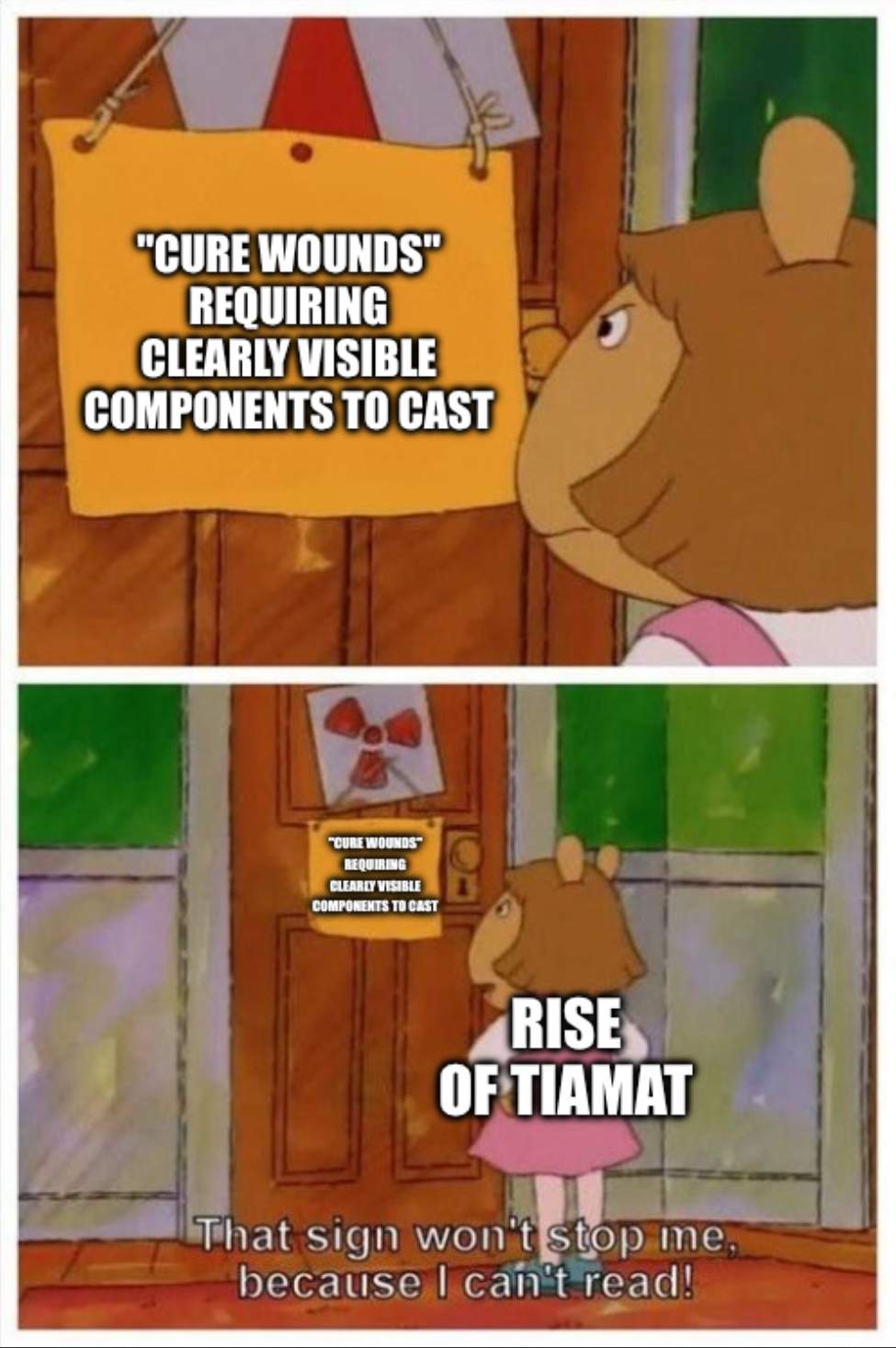
For reference: There is a duell in the module where a shaman tries to secretly help one NPC by continously casting Cure Wounds on him while supposedly only helping him “stand up” after he intentionally let‘s himself fall prone. To spot this, a PC has to specifically declare checking for interventions a then suceed a DC 15 perception-check despite being within earshot…
What do you mean official statblock? As in it’s a statblock from the dmg/mm? Then they can still just tack in things they want/need (as can you, as dm).
I agree they probably could (and should) have better specified that this diverges from the stat block, but the point of the module is to try and cater to everyone, including rewarding players that took points in perception here apparently.
I think it’s got its pros and cons, I’m very fond of seeing all the rules and following them, even as a dm, so 3e (and Pathfinder) were always more my thing, but having played 5e nowadays (and other, even more “you have a 5 damage power, flavour it however you like” like mutants & masterminds) I kind of like the dm style of “know your players, make exceptions where it would increase enjoyment and/or add an interesting challenge without breaking the future fun of the game” too.
Arguably that’s the difference between DM and GM. A DM is just running a dungeon. A GM is running the whole game, rules and all.
Yes they could. But they did not. That’s what I’m crititicising. Perception is one of the most used skills ever. It would not have hurt not to use it here. And if you really want to, then give her some kind of ability that actually let’s her do that, because these kind of things can be missleading to new players/DMs and put extra work on the DM.
And I really like less strict systems like M&M too, but if you write something in a more rigid system, you should adhere to the rules of that system. Or in this case: You shouldn’t start writing full on adventures in an unfinished system.
But that’s my point, 5e is already not a rigid system.
It is in this regard. It might be poorly balanced, but there are rules for things like the sound a spell makes or the specific spells available to NPCs. There are a lot more rigid systems, but DnD definetly isn’t on the casual side either.