
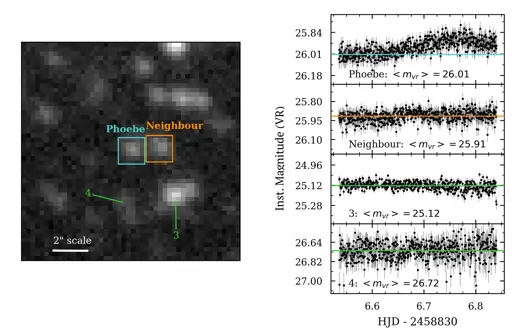
…In May 2026, a team of researchers reported evidence for primordial black holes (PBHs) by spotting a short-lived flicker of light from a star in the Large Magellanic Cloud. They monitored millions of stars in this galaxy using DECam. They spotted one star that briefly brightened for less than an hour. They interpreted this as a gravitational microlensing event. Microlensing occurs when a tiny object passes in front of a star and its gravity briefly bends and magnifies the star’s light like a lens.
Because the brightening was so short, they calculated the “lens” causing it must have had about the mass of the moon. This one-time, nonrepeating signal was interpreted as a microlensing event caused by a primordial black hole nicknamed “Phoebe.”…
In this new study, Udalski and Mr.óz present an independent analysis of the same public DECam data, plus extra observations from 2020 and 2021 that the previous paper didn’t include.
They found that the star brightened at least three separate times over the years—one of which was previously interpreted as a microlensing event. In addition, its average brightness also changed over time…
“This is not the first time that a variable star has been mistaken for a short-timescale microlensing event in high-cadence time-series observations of limited duration,” the researchers note. Short-term monitoring lasting some days, they explain, simply isn’t enough to tell the difference. Distinguishing a genuine one-time gravitational event from a star’s natural flickering requires months or years of monitoring.