
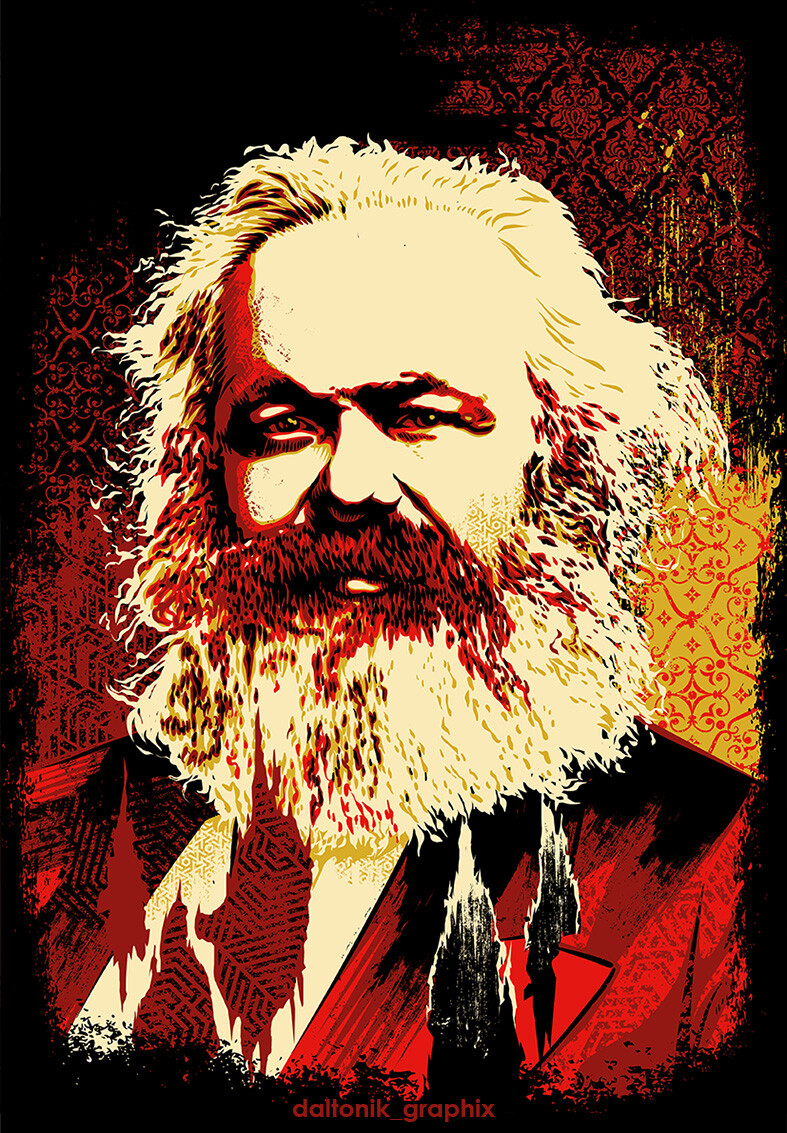
I’m basically center-left and a market socialist who supports multi-party politics and democracy, and I wish to broaden my horizons on Marx. Sometimes I tell myself “I gotta study Marx”, but I can’t.
I also need help internalizing what I’ve studied about Marxism and incorporate in my political views.
Any answer is appreciated. Thank you!
Revisionism question aside, I think Capital is still the best explanation of the fundamentals. It remains relevant as an intro text, being written and published for a lay audience, not academics. Certainly Marx did publish lots of esoteric stuff; one can wade into the weeds about Marx’s views on political economy in Theories of Surplus Value or Grundrisse or the 1844 Manuscripts. But Capital doesn’t occupy the same category.
I haven’t seen a summary of Capital that properly captures all of it including the dialectical aspect. Modern thinkers are primed to think analytically rather than dialectically. Therefore many presentations of the concepts have an analytical bent. If someone manages to capture it fully, I imagine it would be just as long as Capital, so one might as well just read the original.
About the physics thing, I think I was unclear. I don’t mean we should teach quantum to high schoolers or something. I mean rhe opposite: if a student cannot make sense of the original paper, they probably don’t have any business learning the “modern” version of the ideas either! But once it is decided to teach someone quantum mechanics, we should ground that in some level of interaction with the literature, not only summary.
Of course there are exceptions, but I have in mind those theories that have a concise original paper, like Einstein’s papers on relativity or on the photoelectric effect. Some other theories are of course built up over decades across many authors and cannot be localized to a single paper. In summary, I think physics students could be better trained to philosophize about physics, rather than being taught the popular interpretation so that they can be rushed into the next thing. Though… we’re kind of in a time where physics training is not valuable at all for getting a job, so maybe none of this matters in the real world…
A lot of utopian socialist tendencies, like ultraleftism, stem from people reading Capital and nothing else. They end up coming out of it critical of capitalism and having ideas as to what socialism should look like, but no historical or dialectical materialist analysis, so they don’t really get the point of Capital.
They still see things in static terms, don’t understand the relevance of analyzing capitalism’s development other than saying it’s bad, see socialism as just a list of policies you implement and anyone who doesn’t implement that list is a “revisionist” or “capitalist roader” etc.
They go into Capital with no understanding of dialectics and miss the whole point because they interpret it all under a metaphysical lens. Personally I think Critique of the German Ideology is the most important fundamental. Anti-Durhing is very good too. I’d implore people to read those before reading Capital.
I see where you’re coming from and I agree that many bad Marxists read only volume 1. Though, I don’t think the German Ideology is the right pedagogical starting point. In a sense it is the logical starting point, because it summarizes the basic principles of M&E against their peers. But it is an esoteric text nonetheless. The average communist need not read about the history of German Idealism. I say that, keeping in mind what you say about the importance of that text for Marxism as a whole; I agree with that. But there are different roles of communists. The majority are not intellectuals and are not interested in being intellectual Marxists. They need only the essentials for their practical circumstances. It’s only the party cadre who needs to understand Marxism thoroughly, to trace the history of socialist theory through the twists and dead-ends, to have a complete understanding of dialectics. There’s a reason that Marx did not directly mention dialectics in Capital despite “coquett[ing] here and there with modes of expression peculiar to him” (Hegel). It would have made the text inaccessible to the masses. Moreover he and Engels were more than happy to leave “to the gnawing criticism of the mice” the manuscript that we know as the German Ideology, so it’s hard to conceive of it being essential if they did not think so.
The problem of ultraleftists being poor Marxists is more like someone quitting piano lessons too early and developing poor habits as they continue. The problem is not the order of the lessons, nor the essentials as such, but the lack of guidance throughout the training.
Reading this back a little bit, I should say that I also agree strongly that dialectics cannot be sacrificed or diminished. They are essential to Marxism. But what I mean to say is that conscious study of dialectics is a bit too advanced for introduction.