

- cross-posted to:
- civil_religion@lemmy.dbzer0.com
- cross-posted to:
- civil_religion@lemmy.dbzer0.com
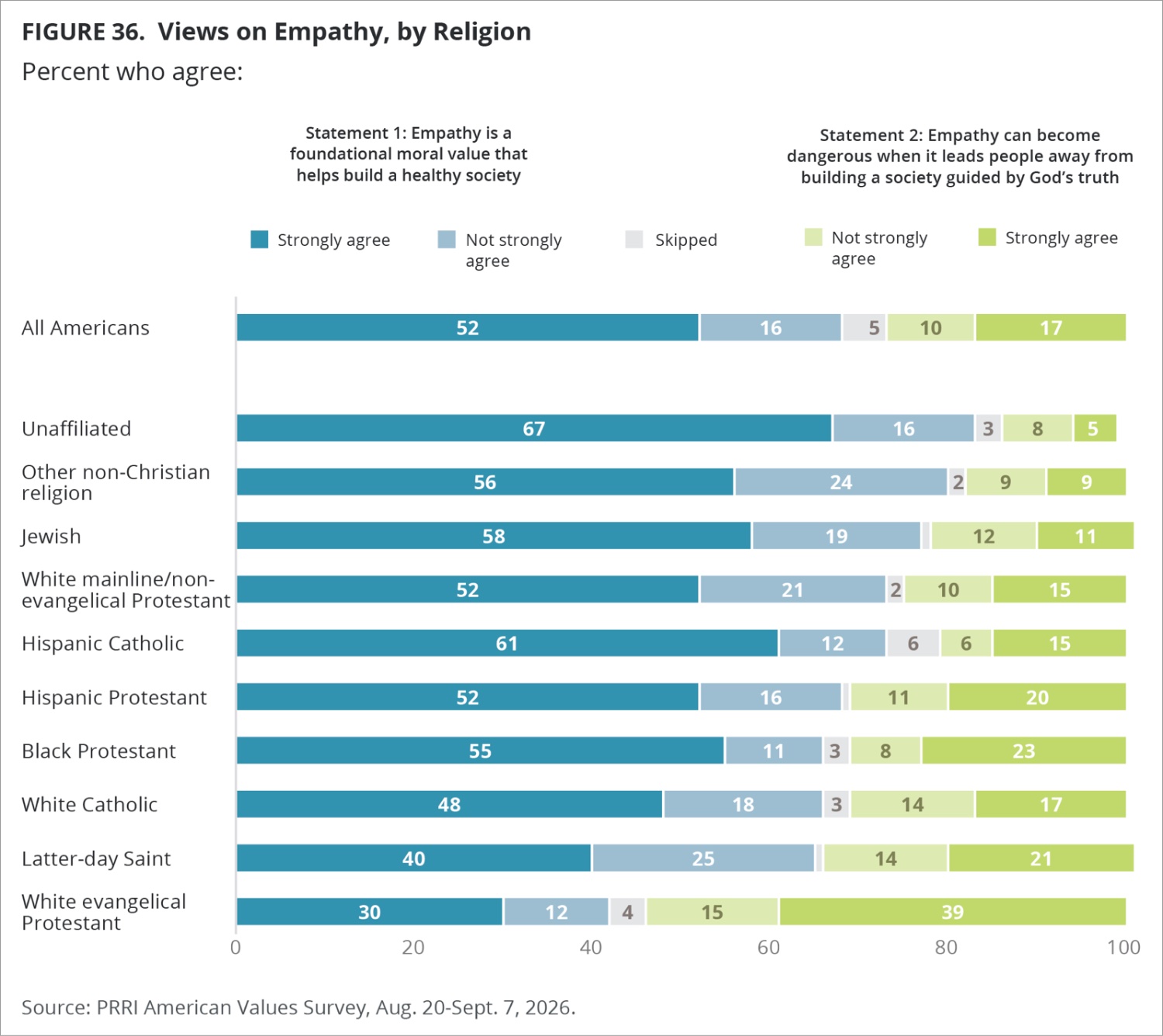
Religiously unaffiliated people most strongly believe that empathy is a foundational moral value. Note that doesn’t necessarily mean atheists; people who believe in God but don’t associate with any particular religion would be in that group. In fact, I can’t find any information about whether atheists are included in this survey, or if this was exclusively a survey of religious people.
Interesting (but not exactly surprising) results here. Makes me glad that “religiously unaffiliated” is the fastest growing religion in the U.S.
You must log in or register to comment.
Picture a lecture hall where an eager student poses what seems like a simple question: “What marks the birth of civilization?” The student, like many of us, probably imagined ancient tools, artistic cave paintings, or early weapons. But anthropologist Margaret Mead’s answer would forever change how we understand human progress. “A healed broken femur,” she said, leaving her audience stunned. In that single, unexpected response, Mead revealed a profound truth about what truly sets humans apart from all other species. In nature’s harsh reality, a broken leg is essentially a death sentence. A wounded animal cannot flee from predators, cannot quench its thirst at the waterhole, cannot hunt or gather food. It becomes vulnerable prey, destined to become another creature’s meal long before its bones could ever heal. But a healed femur tells a different story a uniquely human story. It speaks of compassion, of sacrifice, of one person choosing to stay behind with an injured companion. It tells us of someone who hunted and gathered food for two, who protected and nursed the injured, who put their own survival at risk to ensure another’s recovery. This was not just about medical care; it was about something far more fundamental: the choice to help another human in need. As Mead so eloquently concluded, “Helping someone through difficulty is the starting point of civilization.” In these words, she reminds us that civilization is not built on tools and technologies, but on our capacity for compassion. The true measure of human progress is not in the weapons we forge or the cities we build, but in our willingness to care for one another."

While I agree with the sentiment, it really doesn’t add much to the community to just post a big AI-generated response here. I want to hear your ideas, in your own voice. That’s what a community of people is all about.
It is not AI generated. It is both sad and worrying that anything written with correct spelling, punctuation, grammar and erudition is assumed to have been generated by a machine not a sentient human being.

As a resident of Utah, I’m surprised by the Mormon numbers. Kinda. In my experience, many Mormons outside of the Idaho-Utah-Arizona belt tend to be more liberal, so that might be why.
Seeing the numbers for blacks and Hispanics saddens me. That’s how the Republicans manage to get votes there.
Hi fellow Utahn! SLC here. I kind of expect Mormon numbers (across all kinds of opinions) to more closely match Evangelical numbers going forward. To me, it looks like Mormons fall into two groups these days: those who are all-in on the alpha male/tradwife culture, and those who are on their way out of Mormonism. The first group will make LDS opinions match Evangelical opinions, especially when the second group is no longer included in the LDS numbers.
I don’t intuitively disagree with the premise that non-religious people are more motivated by empathy than religious people, but statement 2 using the phrase “God’s truth” seems like it would make atheists or agnostics less likely to choose it than if it were worded more neutrally.
The issue is that propaganda has redefined “empathy” to mean “giving tons of free money to freeloading brown people”, which makes it an easy thing to turn ignorant racists against.
The other issue is that the US education system has failed rural citizens to the extent that many of them are ignorant racists.
Are these numbers supposed to be a revelation or give new insights? If you asked me if empathy should get in the way of justice and ritiousness (not divine interpretations, just morally correct), I would also say hell no. People don’t want anything to be allowed to get in the way of what they beleive is the ultimate correct thing-
They are also known as morons, deluded or sociopaths. When one person suffers from a delusion it is called insanity. When many people suffer from a delusion it is called religion. Vance and Musk come to mind.

Listen, I am not a big fan of religeous people either, but I think that whole ‘calling them all delusional’ thing most internet atheists do is kind of not ok. First of all, delusions are a very real psychology term, which, to some degree would apply to religious beleifs, but also not, because technically the arguement that all of their bullshit can’t be disproved is actually valid.
And then secondly, it is only said to insult them. It adds no helpful insights, and just sounds edgy for the sake of it.
But besides all that, I was really just trying to say that of course they would choose “God” over “Empathy”. We would all choose our own “gods” over any single virtue, because we all consider our “gods” to be the most virtuous things, whatever they may be to you.
If you don’t pick your “God” over “Empathy”, then it is NOT your “God”.
‘If God exists, why does he behave like a narcissistic absentee landlord with a flair for blood rituals and dietary restrictions? The Abrahamic deity, revered across continents, seems less like a cosmic architect and more like a Bronze Age tribal chieftain with anger management issues. Yet billions genuflect before him daily. Religious faith is often praised as a virtue. But what other domain celebrates belief without evidence? Would you board a plane built by someone who “just felt” the wings would hold? Would you trust a surgeon who prays instead of sterilizing instruments? Richard Dawkins famously called faith “a process of non-thinking.” Yet society elevates it above reason, as if ignorance were a badge of honour. Why is faith exempt from the scrutiny we apply to every other claim? Religion thrives not because it is true, but because it is comforting. It offers immortality, cosmic justice, and a celestial surveillance system that rewards obedience. Freud called religion “a universal obsessional neurosis.” Is it any wonder that belief correlates strongly with existential insecurity? Consider: If you were guaranteed eternal life through science, would you still need God? Or is belief merely a coping mechanism dressed in sacred robes? The Bible commands love, yet sanctions genocide (see Deuteronomy 20:16). It preaches humility yet demands worship. It forbids murder yet glorifies divine slaughter. If morality comes from God, why does it resemble the ethics of a medieval warlord? Sam Harris argues that morality predates religion and is better served by reason and empathy than by scripture. So why do we outsource ethics to ancient texts? Enter the Flying Spaghetti Monster, the Church of the SubGenius, and the Invisible Pink Unicorn parody religions that expose the absurdity of faith by mimicking its structure. Ethan Quillen’s “The Satirical Sacred” explores how these mock faiths challenge religious privilege and reveal the arbitrary nature of belief. Ask yourself: If a belief system is indistinguishable from parody, should it be taken seriously? Religion is not benign. It fuels sectarian violence, suppresses scientific progress, and enforces archaic social norms. From the Crusades to anti-vaccine movements, faith has often been a force of regression. Shouldn’t beliefs be judged by their consequences? Religion persists not because it is rational, but because it is ritualized, institutionalized, and incentivized. It is a cultural fossil revered, untouchable, and absurd. The atheist does not merely reject God; he rejects the intellectual laziness that sustains Him. Do you believe because it is true, or because you were told to? And if the answer is the latter, what else might you be wrong about?’

Ummm, yes? You aren’t incorrect?
I don’t beleive in a god other then the univese/physics/the natural processes themselves.
I was just saying that it is absolutely not surprising that if you beleive in something in a religeous way, you’d choose it over what you consider lesser virtues.
I would rather, for instance, stop global warming then end world hunger. This is entirely because I revere the planet itself more then human life in a very spiritual feeling way.
The most common impediment to clear thinking that non-believer must confront is the idea that the burden of proof can be fairly placed on his shoulders: “How do you know there is no God? Can you prove it? You atheists are just as dogmatic as the fundamentalists you criticize.” This is nonsense: even the devout tacitly reject thousands of gods, along with the cherished doctrines of every religion but their own. Every Christian can confidently judge the God of Zoroaster to be a creature of fiction, without first scouring the universe for evidence of his absence. Absence of evidence is all one ever needs to banish false knowledge. And bad evidence, proffered in a swoon of wishful thinking, is just as damning. But honest reasoning can lead us further into the fields of unbelief, for we can prove that books such as the Bible and the Quran bear no trace of divine authorship. We know far too much about the history of these texts to accept what they say about their own origins. And just imagine how good a book would be if an omniscient Being had written it.

The way people talk about empathy on the fediverse while denouncing and haranguing people they claim to lack it tells me they haven’t really internalized it, and they maybe talk it up for social currency.
Empathy can only approach fair & impartial judgement when we apply it equally by extending it to those we don’t relate to—when we seriously try.
I have (and probably everyone has) observed enough people rush to judgement with a great deal of empathy for those they can relate to while making 0 effort for people they don’t understand.
They’re assholes with empathy.Empathy is trendy to invoke, especially in social media.
The popular premise seems to be that we can solve the moral failings in society if we’d all just develop our psychological health to better contemplate how others feel.
While that may help, it’s incredibly reductive.Feeling is a very low bar that doesn’t set a standard.
Empathy doesn’t stop someone from being an asshole.
It doesn’t imply proper action or duty.
A subjective feeling prone to error, misjudgment, and uneven results is not a reliable basis of moral judgment & conduct.Plus, it seems like a reversion to a type of virtue ethics that suggests morality simply amounts to having empathy.
Isn’t it a bit more than that, and aren’t there systems of ethics to better model it?I remember a time when instead of talking about empathy, people talked way more about acting & treating everyone with basic decency and standards.
They might have even brought up a social contract or the golden rule.
They’d imply society has or ought to have rights, duties, and universal principles to judge moral conduct.
Those quaint ideas at least affirm some objective, external standard unlike empathy, and I think it’s overdue to restore those ideas to prominence in popular discourse.See?
Like right there: I explain that there’s way more to morality & ethics than empathy (whose flaws are obvious enough to motivate philosophers to base systems of ethics on universal principles instead), and someone too superficial to bear the thought that their sacred cow has legitimate issues goes downvoting instead.
Empathy at the fediverse is performative.
Purporting to care about empathy, however, is very popular.
The survey may just reflect that superficiality when serious ethicists & philosophers wouldn’t consider empathy a great foundation either.Empathy is in vogue because the vice president of the United States declared it an illness. You’re getting downvoted because you wrote a lot about the shortcomings of others from a high pedestal (me and unnamed philosophers know better). Empathy is the first step in Christian values, since Jesus explained all the rules can be simplified to “In everything, then, do to others as you would have them do to you.” This not possible without empathy, it is not the end of it all, but the first step.
Complaining that the crowd around you is fake and performative will always be received poorly by the crowd around you. Hence the downvotes. Complaining about the poor reception of your comment shows a surprising lack of self awareness.
And that other shit Musk.

I’m not actually sure that empathy is the “first step in christian values”. First Jesus wasn’t all that empathic- If he was he’d have tried to overturn slavery and wouldn’t have used the Pharisees not stoning kids as a gotcha.
The reason we see an awful lot of awful shit crop up in christianity is because Jesus was just a dude. An iron age religious fundie nut job that wanted to re-institute bronze age morality law rather than use empirical observation to realize that maybe the bronze age morality law had some problems.
“Imagine that you were omnipotent, omniscient, and master of the entire universe. You decided that you were going to give one, just one book to humanity. It would be their moral compass, an insight into their nature and into yours, and act as a guide for how they could live rightly and walk a path that would lead their souls into an eternity with you. Obviously, the first thing you would want to put in there are some totally unscientific, archaic behavioural codes for menstruating women, and for pregnant women after they give birth. You would want to be sure to help them regulate slavery and specify how badly they were allowed to beat their slaves. And of course, you would want the book to be chock full of mythology a creation myth, a flood myth, a fictional exodus, and hagiographical stories about how your loyal armies killed the shit out of everyone who dared to worship the wrong gods. There is a point here about the Bible that, in any estimation, really cannot be understated: there is absolutely nothing in the Bible that could not have been simply made up by Bronze-Age human beings. Nothing at all. There are no profound scientific insights that such cultures could never have known. There is some bogus cosmology, a flat Earth, and instructions for how to slaughter animals among other profound insights. Now, some Christians are keen to point out that the Jews did apparently get some things right. They had “Imagine that you were the perfect, omnipotent, all-knowing Lord and Creator of a sanitation system… but so did ancient Egypt, the Hittites, the Elamites, and the Aegean civilization. So, big whoop. They also had some codes for cleansing themselves after handling dead bodies or people with leprosy, but these rituals also included ritual animal sacrifice. Not exactly innovative. Moreover, the rituals themselves were stupid- after handling a corpse, for example, you would be “unclean for seven days” [Numbers 19:11]. This obviously had little to do with hygiene. Then we have the New Testament. Written by anonymous authors decades after the events purportedly happened and filled with internal factual contradictions, with no trace of the original manuscripts and thousands of copies rife with errors, there is nothing about the New Testament that demands that a rational person should believe it to be divinely inspired. I challenge Christians to show that the evidence demanded that we believe the supernatural claims of the Bible are anything more than made up. There is simply no reason whatsoever for any rational person to make such an assumption. Is the Bible really the best God could do? Is this book of myths, scientific blunders, and ambiguous or even downright demonstrably bogus historicity really what anyone really thinks the omnipotent Lord of the universe would bestow upon humanity? That this God would ignore humanity for the bulk of its 200,000 plus years on the Earth, only deciding to reveal his One True Religion to a small, mostly illiterate Bronze Age tribal culture? Think of all the things the Bible could be if it were really divinely inspired. Think of all the knowledge and insight such a holy book could contain that simply could never have been made up -profound scientific insights, timeless moral instruction, and revelation clear enough to prevent the innumerable schisms in Christian theology over fundamental issues, like how to attain salvation. Any sane, rational view of the Bible shows it to be little more than the confused scribblings of ignorant Bronze or early Iron Age tribes."

And Musk!


