


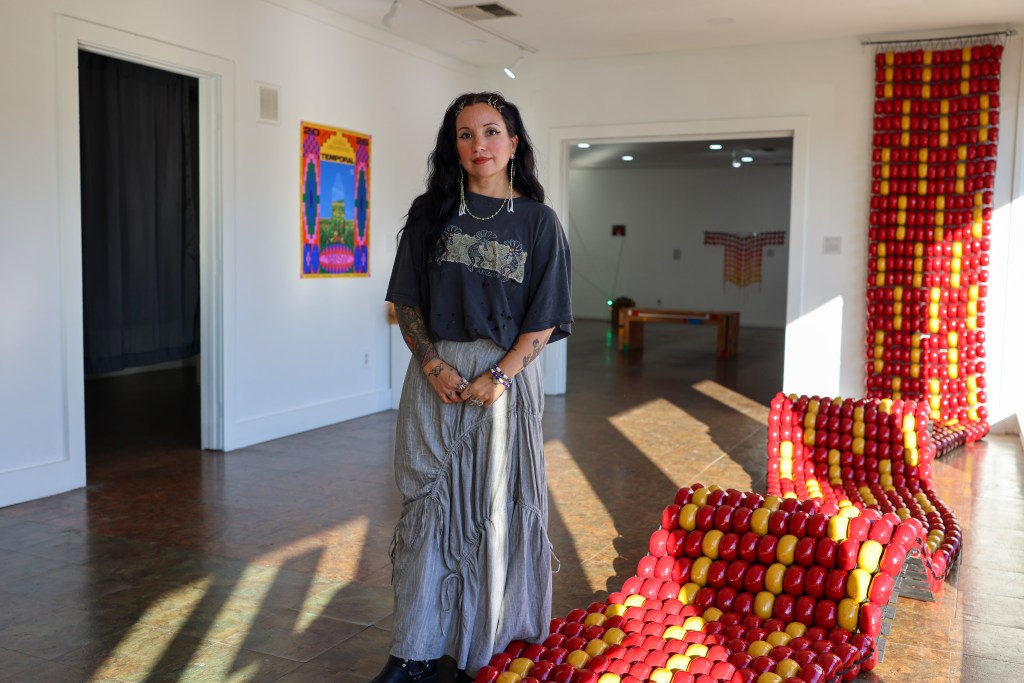
Nika Bartoo-Smith
Underscore Native News + ICT
OLYMPIA, WA — Since Oct. 2, the Coast Salish Museum of Fine Arts has “taken over” the Thurston County Museum of Fine Arts for a two month exhibition.
Through Dec. 11, “Temporal: Stories of Indigenous Present, Re-imagining Indigenous Futures” features work by 14 Indigenous artists interpreting their own ideas of Indigenous futures through mediums including performance art, digital art, paintings, sculpture and traditional Indigenous art forms such as beading and weaving.
Now in its fourth year, the Coast Salish Museum of Fine Arts is an annual takeover in which the Thurston County Museum of Fine Arts hands the keys over to Indigenous Creatives Collective for a two month show.
Exhibition curator, Mikaela Shafer, Hopi, was inspired by thinking about how Indigenous people are often perceived as “relics” or “artifacts” of a past rather than looking at the present and future in today’s gallery and museum spaces.
“We wanted to create a space that showed that Indigenous people are here in the present, and we have ideas for the future, and we create all kinds of art beyond just traditional art,” said Shafer.
An artist herself, Shafer wanted to curate an exhibit that encouraged Indigenous artists to take up space and have full creative control.
The theme, “Temporal,” came to her after seeing a beadwork sculpture by Tammie Dupuis.
“I saw a picture of the “Long Walk” on our Indigenous Creatives roster, and it made me so excited thinking about a future where all of the public art and all of the decor was all Indigenous, and people’s furniture was Indigenous-made, and this idea of a future where we are fully represented in the lands that we are from,” Shafer said. Indigenous Creatives is a woman-led nonprofit based in the Pacific Northwest focused on land stewardship and amplifying Indigenous artists’ voices.
With the exhibit, Shafer sought to hold space for each artist to express their ideas of the Indigenous future they envision.
Underscore Native News + ICT interviewed seven of the 14 featured artists.
Tammie Dupuis: ‘No longer a craft’
Tammie Dupuis, Confederated Salish and Kootenai Tribes of the Flathead Reservation, makes her own beads, the size of a fist, out of resin, cast foam and paper clay in order to turn beadwork into sculpture.
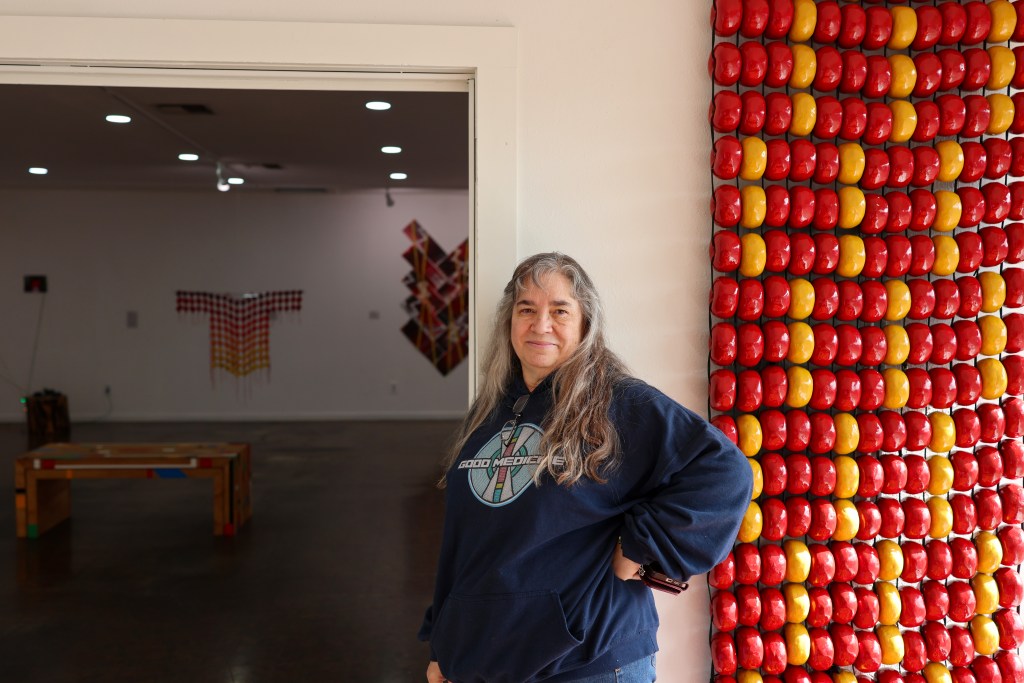
Tammie Dupuis, Confederated Salish and Kootenai Tribes of the Flathead Reservation, is one of 14 Indigenous artists whose work is part of an exhibit at the Thurston County Museum of Fine Arts. She poses for a photo on October 15, 2026. (Photo by Nika Bartoo-Smith, Underscore Native News / ICT)
“It dominates the space,” Dupuis said, speaking about her piece “Long Walk” that commemorates the forced removal of the Bitterroot Salish people to the Flathead reservation. “I think the statement behind that is that this is no longer a craft. I mean, it’s beadwork, but it’s no longer a craft. It’s actually a sculpture. Because my personal feeling is that craft is a word used by fine art to keep women and minorities out.”
Each year, Dupuis adds another row of beads to her living art piece, commemorating the 1891 removal and marking its passage of time.
In her other piece on display at the exhibit, Dupuis created a war shirt out of resin beads, each face sculpted in the beads representing an ancestor giving her strength.
The colors in the beads, ranging from deep red to yellow, also represent the passage of time and a reflection of herself — the yellow at the bottom representing herself as a white-presenting Indigenous person.
“Time is a huge thing for me because I look a lot at the assimilationist systems that produced me,” Dupuis said. “I am, for all intents and purposes, exactly what the reservation system was designed to produce — an Indian so white as to be unrecognizable. And it took me a while to really make peace with the fact that whatever this voice is inside of me, it is Indigenous, and if I silenced it, I would be doing the work of the colonizer.”
Ash Frantz: ‘Imagining this other space’
Weaving cedar in new ways, Ash Frantz, Makah Tribe, brought the idea of Indigenous futures to life by playing with what’s possible.
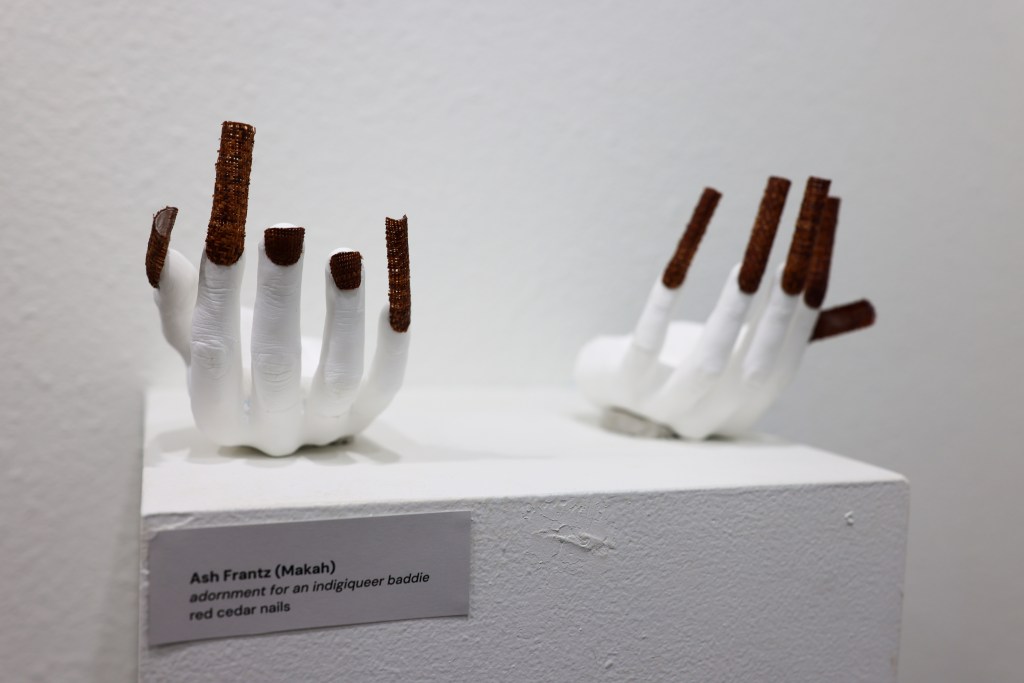
Woven red cedar nails, made by Ash Frantz, Makah Tribe, are displayed at the Thurston Museum of Fine Arts on October 15, 2026. (Photo by Nika Bartoo-Smith, Underscore Native News / ICT)
One of their pieces features a mold of their own hands with intricately woven red cedar nails “for an Indigiqueer baddie.” In this piece, Frantz thought about bodies as an extension of the land and wanted to find a way to decorate queer bodies with the land as well.
“All three of my works that are in this show, but also throughout my whole practice, kind of speak to me imagining this other space or like what the world would look like or could look like,” Frantz said.
In another room, Frantz has installed an obsolete desktop computer from the early 2000s displaying a loading screen with the words “Indigenous Futures Loading,” inviting viewers to contemplate what that means to them.
Next to this piece, a stack of old TVs are placed, as if woven together. They each loop a digital weaving made up of videos of Frantz processing cedar and a video tutorial they watched in the learning process.
“It’s really speaking to the fact that I’ve had to rely on what’s available in the digital realm in our current society to reconnect to my own community cultural practice of working with cedar,” Frantz said.
“This is one of my favorite pieces I’ve made because I’m taking these feelings of not belonging and feeling disconnected and unsure, and I’m turning them into something that feels really comforting and beautiful for me,” they continued.
Cynthia Masterson: ‘The game of Telephone’
Cynthia Masterson, Comanche, has spent nearly the last two decades studying the delicate intricacies of different forms of beadwork — namely, the different styles that often all get called ”peyote stitch” or “gourd stitch”. Her work centers the three-drop stitch, which is unique to Southern Plains tribes.
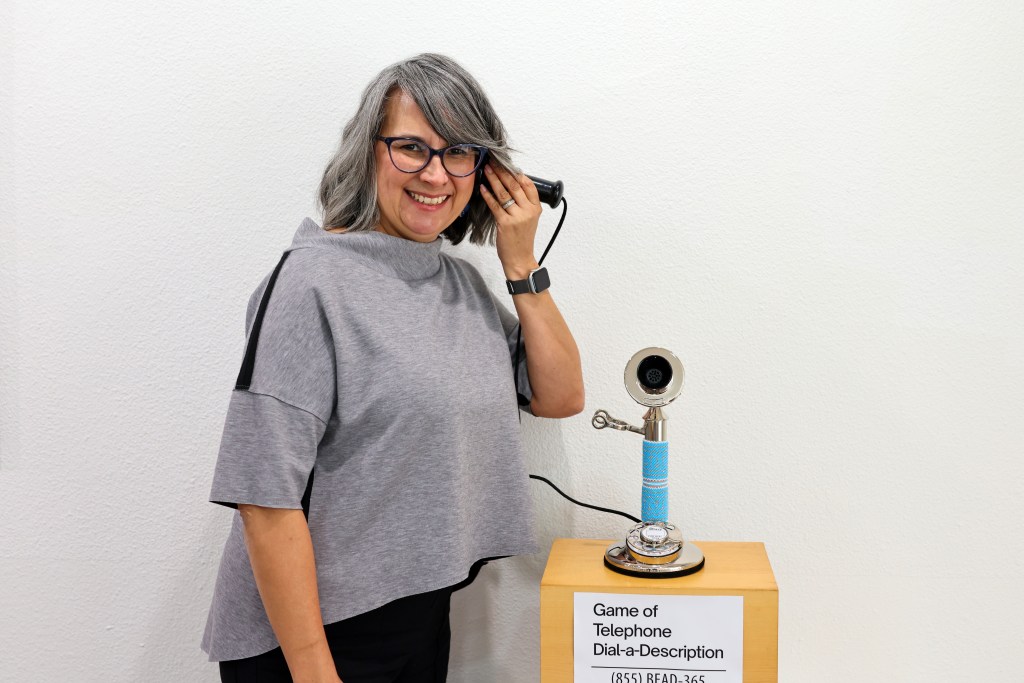
Cynthia Masterson, Comanche, is one of 14 Indigenous artists whose work is part of an exhibit at the Thurston County Museum of Fine Arts. She poses for a photo with her piece, “Game of Telephone,” on October 15, 2026. (Photo by Nika Bartoo-Smith, Underscore Native News / ICT)
As a teacher, much of her artwork is interactive. At the exhibit in Olympia, one piece invites viewers to dial an antique candlestick phone to hear a recording about the beadwork that adorns the phone itself.
“I wanted to do the telephone because it feels like the game of Telephone, like these stitches started and it’s been passed down, and the message has gotten muddled through time,” Masterson said.
Another of her pieces, a vintage gumball machine, encourages viewers to pop in a coin and get back a tray full of beads. She wanted to encourage people to touch the beadwork and have a chance to be creative on their own.
“Growing up, you’re always touching beadwork. It was never in a museum,” Masterson said, thinking about regalia and other forms of beadwork she grew up with. “It’s kind of meant to be interacted with, played with.”
Inanna kʷaɁowišč tyee McCarty: An inside joke turned political commentary
Ever heard of a whale slider? What about an Ozette potato fry? The pop art inspired paintings by Inanna kʷaɁowišč tyee McCarty, a citizen of the Makah Tribe and a descendant of the Tsawout First Nation, depict playful images of each.
McCarty comes from a long line of whalers on her father’s side. The Makah Tribe is the only Native nation in the Lower 48 that has an exclusive treaty right to whaling, but has been blocked from exercising those rights for close to three decades.
Though McCarty’s idea of a whale slider started off as a family joke, it soon became an artistic political statement.
“It was a response to the anti-whaling comics that were in a lot of the local papers in Port Angeles and around the area that were pretty degrading, too, and derogatory,” McCarty said.
Living in Neah Bay, it’s an hour and a half to the nearest grocery store, according to McCarty. This series for her is a part of the conversation about food sovereignty — from whale meat to Ozette potatoes, some of the only foods that can be harvested in the area she said.
“I hope that this makes people think a little bit more about, for one, the land that they’re on, and for two, just the foods that they eat,” McCarty said. “And maybe hopefully taking a little bit better care of each other, the water, seeing people who are different from them as human rather than this monstrous other thing.”
Liz Chikayaasix̂ Morrow: ‘What an Indigenous story can be’
Liz Chikayaasix̂ Morrow is an Unangax̂ storyteller. A citizen of the Naknek Native Village, much of her work is inspired by stories from ancestors and family members of hers that have been passed down.
Reflecting on Indigenous futurisms, Morrow also created a story of her own for the exhibit at the Thurston County Museum of Fine Arts. “Raven Daughter” explores themes of parenthood and choosing to have children.
“The artwork that I make is Native. It is Unangax̂ because I am Unangax̂. So anything that I create is a part of that heritage and is a part of that ancestry,” Morrow said. “I think that’s the story of this exhibit is that idea of ‘this is Native art,’ whether or not you recognize that as an outsider, as a non-Indigenous person.”
She hopes people walk away from her work with an expanded idea of what an Indigenous story and Indigenous artwork can be.
Justin Olmstead: ‘She’s waiting for us to remember’
Justin Olmstead, Santa Ynez and Barbareño Band of Chumash Indians, started painting after he had a dream in which an elder came to him and said he needed to paint sun wheels. Now, sun wheels are a part of every piece he makes.
He said the sun wheels represent confusion, different realities and memories for Chumash people.
Olmstead’s acrylic painting, “Hutash: She’s Waiting for Us to Remember,” depicts Mother Earth gazing into the horizon surrounded by pictographs and sun wheels. It represents a critique of a world that “weaponizes time” with little room to sit, reflect and remember.
“She’s just waiting,” Olmstead said. “She’s sitting here gazing at us, looking at us playing, making these make-believe civilizations and illusions of reality and just waiting for us to come back to her.”
He describes that his work is also a form of storytelling and teaching to pass on to his daughter.
“I started creating all these pieces that’s connected to generational wisdom to give her, almost like generational clarity through the traumas and triumphs,” Olmstead said.
Taylor White: ‘Everything I do is Indigenous futurism’
Taylor White, Skokomish Indian Tribe and Squaxin Island Tribe, lives her life with a love for all things monochromatic. From her own outfits to her home with an olive green living room and baby blue bedroom.
Her latest collection features a skateboard deck, an adorned “Final Fantasy” gunblade, a chair, a breastplate, a bra, deer hoof nunchucks and a medieval mace all covered in purple leather with sparkles of dentalium, pearls and glass beads.
White’s collection feels both fantastical and fierce — created “for the NDN princess.”
“I’ve always been in the belief that modesty was something that was brought over to us [through colonization],” White said. “I’ve never been afraid of my body or shameful of it. I feel like in my family, I don’t think we’ve ever felt shame or felt like modesty was something we lived by, and so when I make things, I just make them for how I was born.”
For White, creating is a form of healing.
“I think inherently everything I do is Indigenous futurism,” White said. “From making new things and decking them out in dentalium and shells or using old things.”
The exhibition runs through Dec. 11 with an artist talk on Nov. 27. For information on the exhibit and open hours visit the Thurston County Museum of Fine Arts website.
This story is co-published by Underscore Native News and ICT, a news partnership that covers Indigenous communities in the Pacific Northwest.
The post Olympia museum takeover explores Indigenous futures appeared first on ICT.
From ICT via This RSS Feed.
Very cool!
Native peoples should make art, go to a museum, and replace the art with their art, and then sit-in.
