

- cross-posted to:
- japaneselanguage@sopuli.xyz
- cross-posted to:
- japaneselanguage@sopuli.xyz
This article features photos of kamidana — household Shinto altars — from around the world, accompanied by commentary from me, a Shinto priest.

🍉From Ikeda (Owner of Soba restaurant)
“We enshrine our local tutelary deity here—not one of the big names like Ise or Izumo, but someone who feels more like a good neighbor. That suits us just fine.
Since we run a soba shop, we don’t offer rice—we offer soba. Whether that’s proper or not, I honestly don’t know, but that’s how we do it.
We’ve placed a Lucky Ebisu statue we received as a gift for our shop opening, along with a bottle of local craft beer from Nanki-Shirahama, designed by a friend.
And in the spirit of Shinbutsu-shūgō (the fusion of kami and buddhas), we’ve also tucked in an ofuda from Sensō-ji that was lying around the house.”
🍑From Toukyo
This kamidana belongs to a friend of mine who runs a soba restaurant in Tokyo.
Soba itself is often considered an iki (粋) food—refined, minimalist, and quietly stylish. This kamidana, too, has that same clean and elegant feeling. There’s something about it that captures the spirit of Edo (old Tokyo): a sense of tasteful simplicity, where nothing is overdone, yet everything feels just right.
One feature that makes this kamidana special, as my friend explains, is that instead of offering rice, he presents buckwheat (soba) grains. I believe offerings should be something the kami can enjoy with us—something shared. While rice is traditionally the standard, it’s perfectly fine to offer locally grown foods or items that reflect the essence of your work.

🍉From Ilya
“I built my kamidana from local pine wood, with the help of my dad back in 2020. It was a real passion project. Neither of my parents practice Shinto, but they support me, and being able to build this with my dad was a really lovely experience.
One of the personal touches I try to add to the kamidana is a custom drawing of the main Kami I worship Tenjin-sama, and calligraphy.
My kamidana has really grown over the last 5 years and I am really proud of where it’s come! Over the years I’ve been able to add Sakaki and masakaki, various items from Tenmangū in Japan, Omikuji and Omamori, as well as kumade and hamaya. The bottom shelf is dedicated to books on Shinto and my goshuincho collection (currently numbering 5 individual volumes).”
🍑From Toukyo:
I was deeply moved by the kamidana she built with her father—it’s truly wonderful. A kamidana is a small sacred space where we can commune intimately with the kami and cultivate a sense of harmony with them. To create that space entirely by hand, with such passion, and to enjoy the very process of making it—that in itself, I believe, is a beautiful way of connecting with the divine.
The character she has placed on the ceiling is the kanji for “cloud” (雲). In Japan, when a kamidana is placed in a room where there is another floor or people walking above it, we often post the character “雲” on the ceiling. It symbolically transforms the ceiling into “sky,” thus preventing the space from being seen as disrespectfully “underfoot” to the kami. This is a cultural technique we call mitate—a poetic way of seeing or reinterpreting something. The fact that she knows and uses this shows a deep understanding of Japanese culture rooted in Shinto.

🍉From Jeff
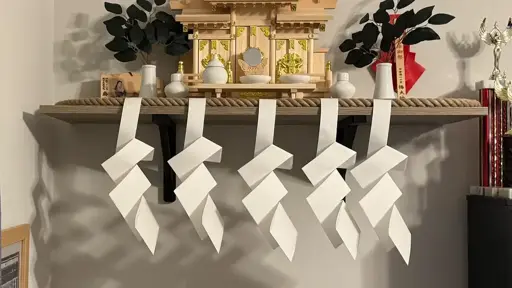
“It is a basic three-door Miyagata with Jingu Taima in the center, flanked by ofuda for Sarutahiko-Okami and Ame-no-Uzume-no-Mikoto. To the left of the Miyagata is an Ema featuring the husband and wife Kami (Our prayer came true, I should mention!). To the right is a Gohei for home protection. I am unsure if the shimenawa laying around the base of the kamidana is acceptable, and I look forward to learning whether or not this is the case.
Shinto appeals to me as a framework in which to express gratitude for health and family, for sustenance, for all of life’s good things, and a place to be introspective about my actions and how they affect the world. ”
🍑From Toukyo
That’s a very impressive and traditional kamidana! The white ceramic utensils are shiny and clean, which shows how well you maintain its purity. I even spotted a sumo ranking chart (banzuke) on the left wall in the photo! (I’m a sumo fan).
Regarding the question about the placement of the shimenawa (sacred rope) and shide (paper streamers), as long as they are positioned above head height, it’s perfectly fine to attach them to the lower part of the kamidana, just as shown in the photo.
For readers unfamiliar with these items, shide are zigzag-shaped white paper strips that mark a sacred space. You can make them yourself by folding a rectangular piece of white paper with alternating cuts. It’s one of the simpler types of origami, so if the paper becomes dirty or torn, it’s a good idea to replace it.
You must log in or # to comment.