Starting a war with Canada would just accelerate the collapse
you have to ALSO maintain a strong military presence in BC and Yukon all the while the locals are trying to fuck you up and the rest of Canada is engaged in guerrilla warfare not only there but also against the US presence in Alaska
the US would be militarilly bogged down for DECADES
I agree with you, but I would wager that Canada’s participation in the F-35 program has more to do with not having the land bridge than your points. We’re already doing our version of “little green men” in Greenlands, so it’s hard to use history or what makes fiscal sense as a guide.
I’m on team No Land Bridge, but I also see the US never giving up Alaska.
The thing with collapsing empires is that it’s not really a choice. You can print all the money you want, your economy only has so much productive potential. The core problem empires encounter is they build their economies and political system based on growth. Rome for example built a slave empire and military machine off the spoils of war. They used the proceeds from one war to fund the next. The slaves captured in one conquest provided the surplus disposable labor to grow the economy to fund further conquest. And its political system was never properly designed to govern such a large area with any degree of stability. The wealth of empire allowed the political instability to be bandaged for a time. But nothing can grow forever. And when an empire fundamentally built and sustained by growth reaches the limits of its growth? It doesn’t just stabilize and level off. Growth was the only thing keeping the whole house of cards stable. Once growth stops, collapse begins.
The problem with collapse is that it works in just the opposite form of imperial expansion. As the economy falters, military spending has to decline. A larger share of the budget could go to the military, but that has to be funded by taxes, spending cuts, or more inflation. These just add to the political instability and shrink the economy further. The needs for the military can be reduced by withdrawing troops from distant theaters, but then those areas become more vulnerable to enemies. As collapse continues, you have to give up territories or lose them to rebellion or conquest. You can neglect your periphery, not invest in it, and lightly defend it, but that just makes those regions likely to rebel. As you lose territories, your economic potential shrinks even further. This collapse snowballs until the whole system disappears entirely, or the empire collapses down to its heartland. That core territory, the one that originally expanded outward to conquer a vast empire, can then stabilize and remain as normal nation.
The US has been on a continuous expansion phase since its founding. Up until WW2 or so that meant actual territorial expansion. After WW2, the expansion has been in the form of an expanding trade empire and an ever-expanding overseas military presence. And up until the last generation or so, that growth served to paper over a lot of the internal contradictions and instability inside the US. The US was pretty unique in its founding in that it was founded through a revolution, but only a political revolution, not an economic one. The leaders of the American Revolution were American merchants and Southern nobles that wanted to kick the king out, seize political control, but keep the existing economic system the same. Contrast this to the French Revolution and most subsequent ones that featured extensive political and economic issues.
The US’s political system has a lot of bugs that cannot be easily patched. The presidency had built-in dictatorial potential from the start. The Constitution is designed to be deliberately difficult to amend. The Supreme Court is poorly designed. There’s no proportional representation, the House and Senate both favor land over population, and on and on. We’ve been trying to patch the system as best we can with amendments and reform laws. But the political system is clearly in decline. The original concept of checks and balances is completely broken. Congress has completely lost the power to declare war. The Supreme Court has become openly corrupt. And the oligarchs have completely subjugated the government to serve their narrow self-interest.
Personally, I don’t see how this ever recovers. The Rubicon has been crossed to many times. It’s clear that when the president violates the law or a court ruling, there’s no real enforcement mechanism to stop them. The Founders fundamentally did not design or Constitution’s structure with political parties in mind.
Our system’s failures were present from the beginning, but growth can paper over a lot of failures. In the 19th century, giving away free land out West was a social pressure release valve. People who got tired of living under the low pay and high rents of the industrial cities back East could vote with their feet and go start a farm out West. In the 20th century, the automobile suburbs and the post war boom created a middle class that served to stabilize national politics. In the 90s and the era of globalization and the expanding US trade empire allowed cheap goods to flood into the country, buoying the lifestyles of that same middle class. (Those fortunate enough to not be in the Rust belt.) And rising home prices over the last 40 years have served to further reinforce that politically stabilizing middle class.
But it can’t go on forever. The US trade empire has hit its limits. Rising home prices helped the older generations, but in turn they made housing prices unaffordable for people starting out. And as a result the birth rate has tanked. For the first time in American history, subsequent generations are poorer than their parents. Real standards of living for most of the population are declining.
This is what collapse looks like. An empire built on growth is only stable while it’s growing. You cannot just stop growth at some point, level off, and stabilize. When growth hits its inevitable limits, the growth process starts working in reverse. The same snowballing process that enabled the empire to grow starts rolling backwards.
This is collapse. Every empire that has ever existed has gone through this expansion and collapse cycle. The US will be no exception. And this is only looking at it from the classic imperial political and economic lens. We haven’t even touched on environmental deterioration and the effects of a collapsing climate.


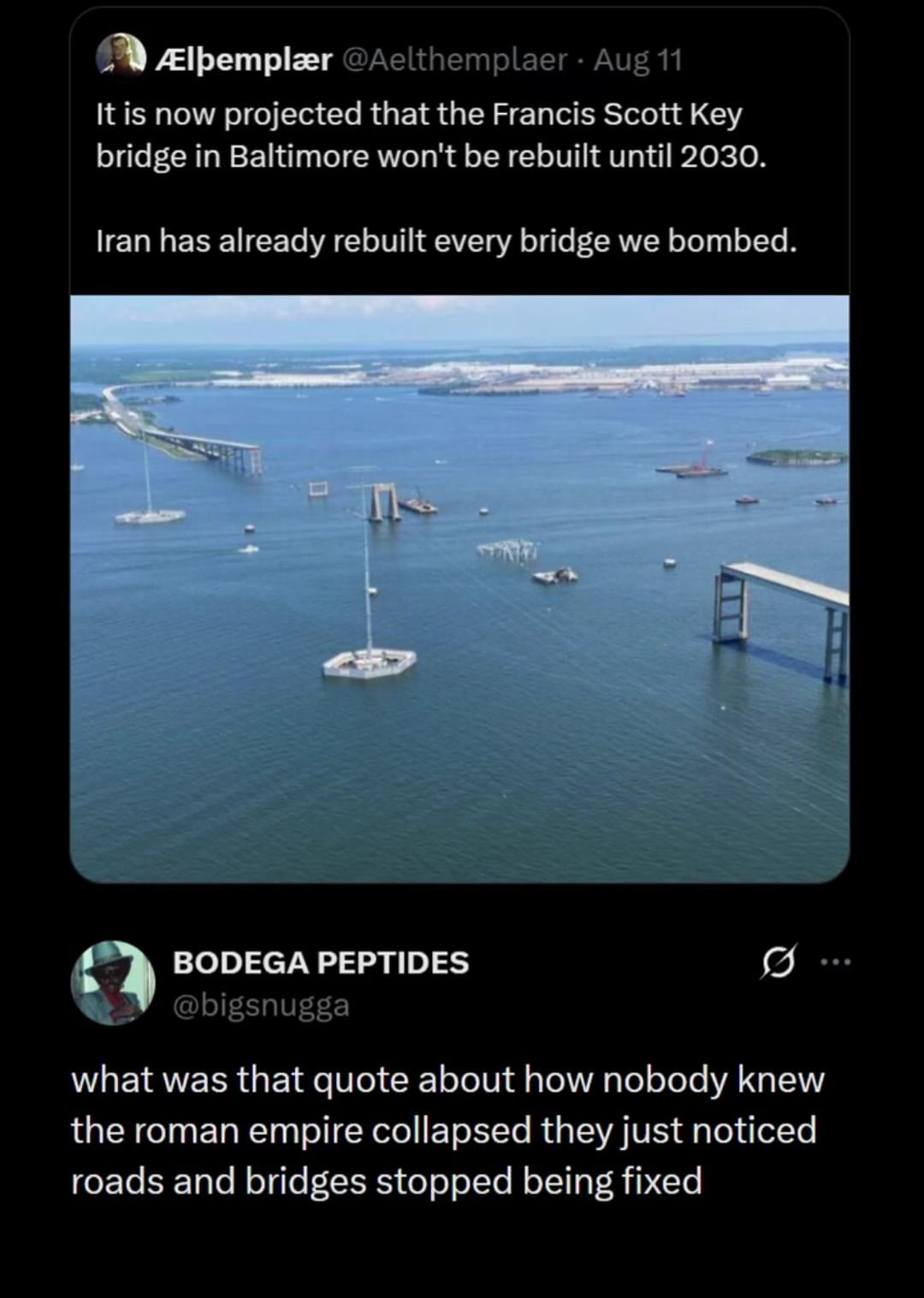
I agree with you, but I would wager that Canada’s participation in the F-35 program has more to do with not having the land bridge than your points. We’re already doing our version of “little green men” in Greenlands, so it’s hard to use history or what makes fiscal sense as a guide.
I’m on team No Land Bridge, but I also see the US never giving up Alaska.
The thing with collapsing empires is that it’s not really a choice. You can print all the money you want, your economy only has so much productive potential. The core problem empires encounter is they build their economies and political system based on growth. Rome for example built a slave empire and military machine off the spoils of war. They used the proceeds from one war to fund the next. The slaves captured in one conquest provided the surplus disposable labor to grow the economy to fund further conquest. And its political system was never properly designed to govern such a large area with any degree of stability. The wealth of empire allowed the political instability to be bandaged for a time. But nothing can grow forever. And when an empire fundamentally built and sustained by growth reaches the limits of its growth? It doesn’t just stabilize and level off. Growth was the only thing keeping the whole house of cards stable. Once growth stops, collapse begins.
The problem with collapse is that it works in just the opposite form of imperial expansion. As the economy falters, military spending has to decline. A larger share of the budget could go to the military, but that has to be funded by taxes, spending cuts, or more inflation. These just add to the political instability and shrink the economy further. The needs for the military can be reduced by withdrawing troops from distant theaters, but then those areas become more vulnerable to enemies. As collapse continues, you have to give up territories or lose them to rebellion or conquest. You can neglect your periphery, not invest in it, and lightly defend it, but that just makes those regions likely to rebel. As you lose territories, your economic potential shrinks even further. This collapse snowballs until the whole system disappears entirely, or the empire collapses down to its heartland. That core territory, the one that originally expanded outward to conquer a vast empire, can then stabilize and remain as normal nation.
The US has been on a continuous expansion phase since its founding. Up until WW2 or so that meant actual territorial expansion. After WW2, the expansion has been in the form of an expanding trade empire and an ever-expanding overseas military presence. And up until the last generation or so, that growth served to paper over a lot of the internal contradictions and instability inside the US. The US was pretty unique in its founding in that it was founded through a revolution, but only a political revolution, not an economic one. The leaders of the American Revolution were American merchants and Southern nobles that wanted to kick the king out, seize political control, but keep the existing economic system the same. Contrast this to the French Revolution and most subsequent ones that featured extensive political and economic issues.
The US’s political system has a lot of bugs that cannot be easily patched. The presidency had built-in dictatorial potential from the start. The Constitution is designed to be deliberately difficult to amend. The Supreme Court is poorly designed. There’s no proportional representation, the House and Senate both favor land over population, and on and on. We’ve been trying to patch the system as best we can with amendments and reform laws. But the political system is clearly in decline. The original concept of checks and balances is completely broken. Congress has completely lost the power to declare war. The Supreme Court has become openly corrupt. And the oligarchs have completely subjugated the government to serve their narrow self-interest.
Personally, I don’t see how this ever recovers. The Rubicon has been crossed to many times. It’s clear that when the president violates the law or a court ruling, there’s no real enforcement mechanism to stop them. The Founders fundamentally did not design or Constitution’s structure with political parties in mind.
Our system’s failures were present from the beginning, but growth can paper over a lot of failures. In the 19th century, giving away free land out West was a social pressure release valve. People who got tired of living under the low pay and high rents of the industrial cities back East could vote with their feet and go start a farm out West. In the 20th century, the automobile suburbs and the post war boom created a middle class that served to stabilize national politics. In the 90s and the era of globalization and the expanding US trade empire allowed cheap goods to flood into the country, buoying the lifestyles of that same middle class. (Those fortunate enough to not be in the Rust belt.) And rising home prices over the last 40 years have served to further reinforce that politically stabilizing middle class.
But it can’t go on forever. The US trade empire has hit its limits. Rising home prices helped the older generations, but in turn they made housing prices unaffordable for people starting out. And as a result the birth rate has tanked. For the first time in American history, subsequent generations are poorer than their parents. Real standards of living for most of the population are declining.
This is what collapse looks like. An empire built on growth is only stable while it’s growing. You cannot just stop growth at some point, level off, and stabilize. When growth hits its inevitable limits, the growth process starts working in reverse. The same snowballing process that enabled the empire to grow starts rolling backwards.
This is collapse. Every empire that has ever existed has gone through this expansion and collapse cycle. The US will be no exception. And this is only looking at it from the classic imperial political and economic lens. We haven’t even touched on environmental deterioration and the effects of a collapsing climate.